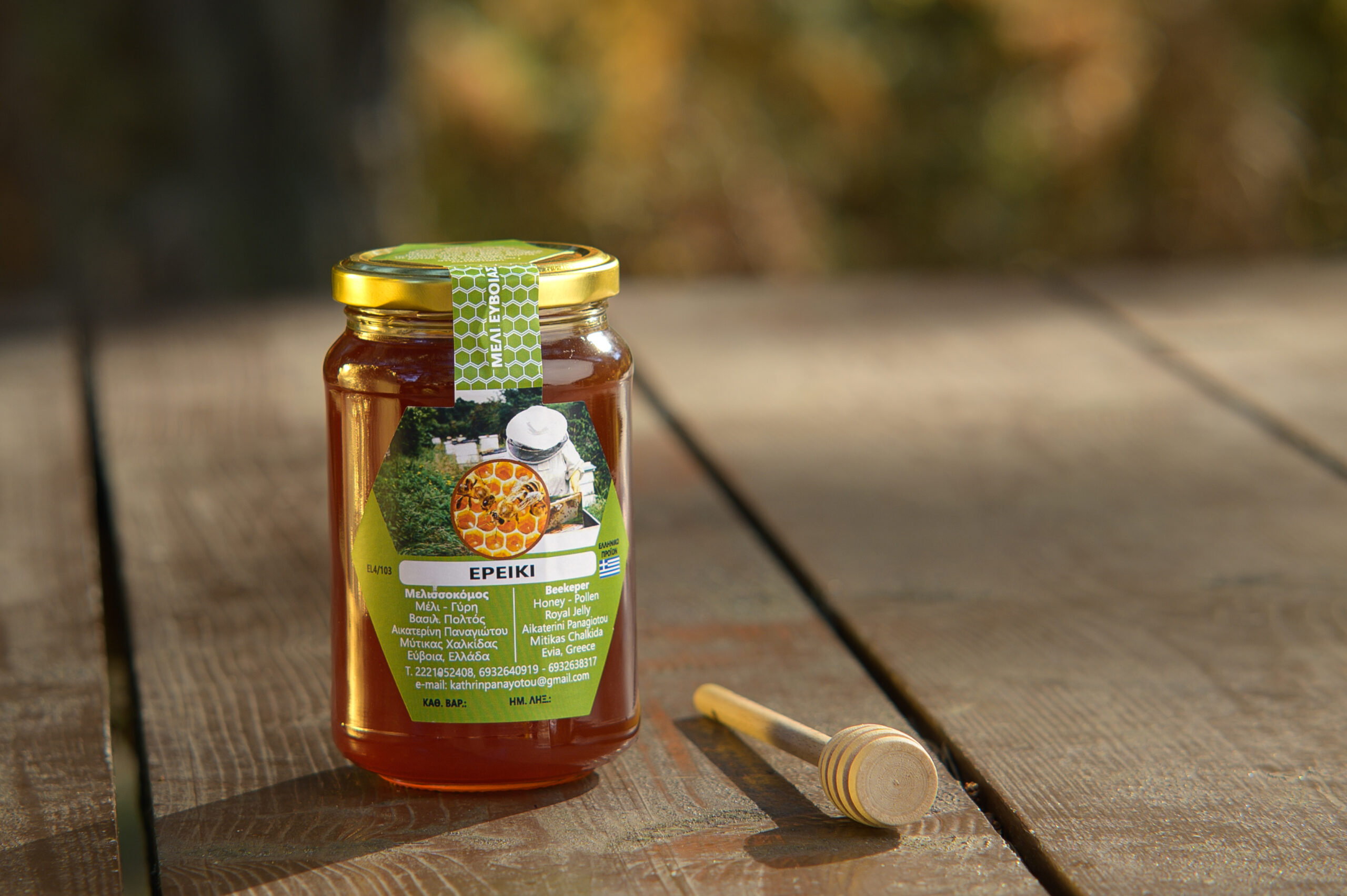
Description
Heather honey is of high nutritional value. It has a copper-red color, intense aroma, characteristic strong taste. It is produced from the heather plant. Heather is a shrub and depending on its species, autumn or spring has different height and color in flowers. Autumn heather is 30cm-80cm tall and pink to reddish flowers, while spring heather is 80cm-3m high with white flowers. The flowering of autumn heather begins at the end of July (South Evia), while in other areas in August, and lasts until December, while that of spring heather begins in spring and can last until June. That of autumn heather is of high nutritional value, due to its high iron content.
Properties:
Honey in general is a food of high nutritional value and can be included as part of a healthy and balanced diet. It has strong antioxidant and antimicrobial activity, due to its content in phenolic acids and flavonoids. It has strong antioxidant and antimicrobial activity, due to its content in phenolic acids and flavonoids. It helps to cope with gastritis, nephrolithiasis, prostate and anemia. Honey generally contributes to the proper functioning of the body, such as the respiratory system, immune, cardiology, digestive, urology, skin diseases, etc.
All types of honey crystallize, some more and others less, while some may never because of their composition. Blossom honeys (honeys derived from flowers, blossoms, light-colored) crystallize more quickly, due to their natural glucose content, while honey species derived from honeydew secretions (honeydew found in coniferous trees) more slowly or never. Heather belongs to the category of blossom honey. It crystallizes quickly.
At this point we need to point out that all types of honey are beneficial for the human body, as long as the honey is produced by the bee, this miraculous insect. The type of honey we choose has to do with what flavor we like, such as some trace elements that it may contain more percent than another variety.
Ingredients:
It contains more than 180 valuable elements, such as carbohydrates – sugars, vitamins, proteins, amino acids, enzymes, minerals – trace elements and organic acids.
Carbohydrates-sugars are the solid components of honey at a rate of 95-98%. About 20 types of sugars have been found in honey, such as fructose, glucose, sucrose, lactose, maltose, isomaltose, trehalose, arabinose, turanose, erlose, sucrose, raffinose, etc.
About 20 types of sugars have been found in honey, such as fructose, glucose, sucrose, lactose, maltose, isomaltose, trehalose, arabinose, turanose, erlose, sucrose, raffinose, etc. The main ones are fructose and glucose with a percentage of 60-70%.
Vitamins that have been found in honey are: B1 (thiamin), B2 (riboflavin), B3 (niacin), B5 (pantothenic acid), B6 (pyrixodine), C (ascorbic acid), biotin, folic acid, A (provitamin or carotene), D, E, B12, K, etc.
Enzymes such as amylase, invertase, lipase, lactase, diastase, catalase, phosphatase, etc.
Proteins and amino acids, such as proline (the main amino acid of honey), lysine, histidine, arginine, tyrosine, leucine, glutamic acid, phenylanine, tryptophan, etc.
Minerals-trace elements, such as potassium, calcium, magnesium, phosphorus, iron, copper, zinc, selenium, sodium (in small content), potassium, chlorine, manganese, sulfur, silicon, etc.
Preservation and storage: Store in a cool and dry place.





kathrinpanayotou –
Lorem ipsum dolor sit amet, consectetur adipiscing elit, sed do eiusmod tempor incididunt ut labore et dolore magna aliqua. Ut enim ad minim veniam, quis nostrud exercitation ullamco laboris nisi ut aliquip ex ea commodo consequat.